PERSONAL DEVELOPMENT · August 27, 2026
Why Planning Is the Discipline That Separates Busy Entrepreneurs From Productive Ones

How the consistent practice of planning every project, week, and decision before acting has produced more results in less time — and how you can build the same discipline
Hervé ONANGA KINGBO · Entrepreneurship · Personal Development · ~880 words · 5 min read.
Most entrepreneurs are not failing because they are lazy. They are failing because they are constantly moving, and almost never stopping to think before they move.
Action without planning is the most expensive habit in business. It produces motion, which looks like progress, but it rarely produces results, which are the only thing that actually matters. The difference between the entrepreneur who keeps busy and the one who keeps building is rarely talent or even effort. It is almost always the presence or absence of a deliberate planning discipline.
Planning as the Discipline That Multiplies Everything Else
Planning is not a preparation for the real work. It is the work, the moment where you decide what actually deserves your time and energy before you spend either. A plan is not a wish or a to-do list; it is a clear, structured decision about what you will build, in what order, and by what means. Every hour invested in serious planning before a project begins returns multiples in clarity, speed, and quality of execution. The problem is not that entrepreneurs do not know this. It is that almost no one has built it as a non-negotiable discipline, something they do consistently, not only when a deadline forces it.
The research confirms what experience teaches. Planning consistently and rigorously is one of the most reliable predictors of goal achievement across domains.
“When people plan how, when, and where they will perform a behaviour, they are more than twice as likely to actually do it.”
— Peter Gollwitzer, Professor of Psychology, New York University — on implementation intentions and goal achievement (1999).
Gollwitzer’s decades of research demonstrate that the act of planning is not merely organizational, it is a psychological commitment that fundamentally changes the likelihood of follow-through. The chart below illustrates what that looks like compounded over time: as the consistency of planning practice rises, so does the clarity of focus, the quality of execution, and, most significantly, the long-term results.
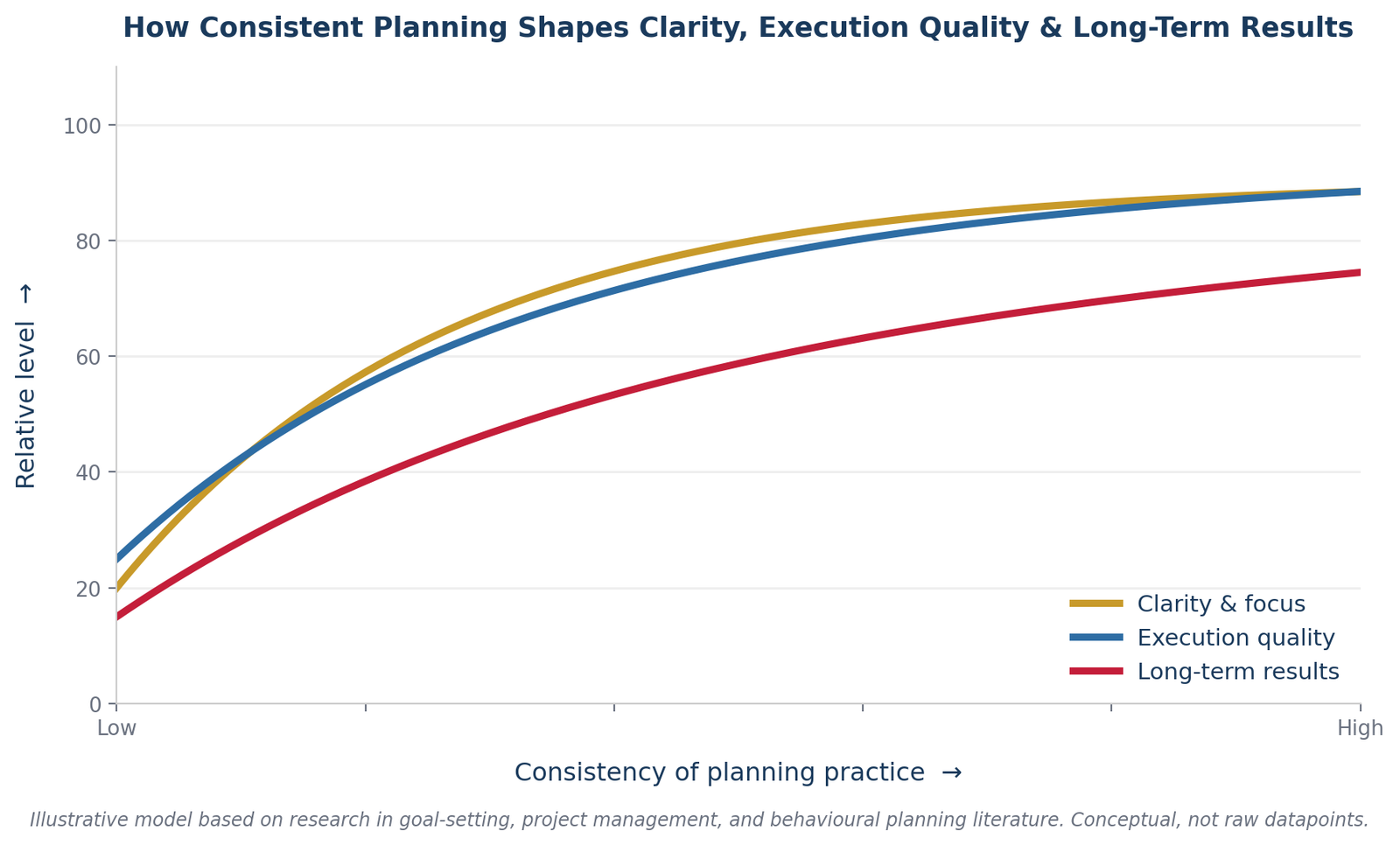
Illustrative model based on research in goal-setting, project management, and behavioural planning literature. Conceptual, not raw datapoints.
Nehemiah understood this long before modern research put numbers to it. When God gave him the vision to rebuild Jerusalem’s walls, he did not immediately gather workers and start hauling stone. He spent time studying the problem, surveying the rubble by night, counting the gates, and calculating the scope of the work before he announced the plan to anyone. Only when he had a clear, structured vision of the whole did he present it to the people, and the text records that they replied, ‘Let us rise up and build’ (Nehemiah 2:18). A plan so clear that people rally to it on first hearing is the fruit of serious prior planning, never of improvisation.
Four Benefits of Consistent Planning That Compound Over Time
- Clarity Before the Chaos Begins
The entrepreneur who plans before acting enters every situation knowing what success looks like, what the steps are, and what the first move is. He is never standing in the middle of a project wondering what he should be doing. That clarity is not just a comfort, it is a productivity multiplier. Unclear goals produce scattered effort; a clear plan focuses every decision and action on what actually advances the objective.
- Better Decisions Made in Advance
One of the least obvious benefits of planning is that it moves your decisions from the heat of the moment to the calm of the planning table. When you have planned in advance, most of the decisions your project requires are already made, and made thoughtfully, without the pressure, the fatigue, or the emotion that corrupt in-the-moment judgment. You have already decided what you will do when X happens, which means X costs you almost nothing when it arrives.
- Resources Used with Precision, Not Burned in Confusion
Time, money, and energy are finite. The unplanned entrepreneur spends them finding out what to do next; the planned one spends them doing it. Planning is how you convert the same finite resources into two or three times the output, not by working harder, but by ensuring that almost every hour goes toward what actually matters rather than what is merely urgent.
- Results That Compound Year After Year
This is the hardest benefit to see early and the most powerful one to live. A planning discipline, maintained consistently across months and years, does not produce linear improvement, it produces compounding results. Each well-planned project builds on the last; each completed season deposits something into the next. The entrepreneur who plans consistently does not look dramatically better than the one who does not in week one. In year three, they inhabit entirely different realities.
“The plans of the diligent lead surely to abundance, but everyone who is hasty comes only to poverty.”
— Proverbs 21:5
The Proverbs contrast is exact: the diligent planner and the hasty actor, and the outcomes they produce are not merely different in degree but in kind. Abundance versus poverty; “surely” versus “only.” Scripture does not present planning as a nice-to-have for the organised mind; it presents it as the discipline that leads surely to abundance, with a certainty attached to it that haste never enjoys. To rush past the planning into the doing is not efficiency. It is the most expensive shortcut available.
“A plan is not preparation for the real work. It is the real work, the moment you decide what your time is worth before you spend it.”
How AI Can Strengthen Your Planning Practice
Planning used to be slow, which is partly why people avoided it. AI removes that friction, not by planning for you, but by helping you think faster, see gaps you have missed, and turn a scattered set of ideas into a structured plan in a fraction of the time. The thinking and the judgment remain entirely yours. Here are three prompts to use before your next project or week.
“I want to plan [PROJECT or GOAL]. Ask me five diagnostic questions, one at a time, to help me clarify the objective, the constraints, the key steps, and the biggest risk before I write a single line of the plan.”
“Here is my rough plan for [PROJECT or WEEK]: [PASTE]. Act as a critical reviewer. Identify any steps that are missing, any assumptions that could break the plan, and any places where the sequence is wrong, without rewriting it for me.”
“Break [GOAL] down into a 90-day plan with weekly milestones. Make it specific enough that at the end of each week I can give a clear yes or no answer to the question: did I hit this week’s target?”
AI sharpens and accelerates the planning process; it cannot supply the conviction about what is worth building, the courage to commit, or the discipline to review what went wrong and plan better next time. Use it for the mechanics; keep the judgment entirely yours.
YOUR ONE ACTION TODAY
Before you begin any work tomorrow, spend fifteen minutes writing a plan for the day, not a task list, but a structured set of decisions: what is the one outcome the day must produce, what are the three activities that serve that outcome, and what is the first step of the first one? Write it before you open your email or your phone. Then, at the end of the day, spend five minutes reviewing it: what got done, what did not, and why. Begin with this prayer: “Lord, order my steps today; let my plans serve Your purposes, and let nothing I build today be wasted effort.” Do this for one week, and you will feel the difference a plan makes more clearly than anything I can write here.
I teach structured planning as part of my broader coaching work — helping entrepreneurs build the disciplines that produce compounding results over time:
My books, including my newest release, are on Amazon: amzn.eu/d/0hJuTK1l.
My courses on AI, technology, and digital systems are on Gumroad: gumroad.com/products.
My worship music, for focused work and reflection, is on SoundCloud: on.soundcloud.com/ig42ZKt4ozytt1gZBV.
Faith-driven merch and resources are in my shop: /shop/.
And for speaking requests: /speaking.